Creator guide · Data insights
How to find YouTube sponsors with fewer than 100K subscribers
Find brands already appearing on smaller channels, check whether they fit your audience, and turn your research into a specific sponsorship pitch.
By DiscoverSponsors · 7 min read
You have a channel people return to, a recognizable audience, and ideas for your next videos. But when you look for sponsors, the same brands keep appearing beside creators much bigger than you.
That does not mean you need to wait for 100K subscribers. It means your search needs to start closer to your own channel.
Look for brands with visible activity on comparable channels, check what kind of partnership actually happened, and pitch a specific video your audience would value. Here is how to do that—with data showing where smaller channels already appear.
Do brands work with channels below 100K?
Yes. We verified explicit sponsorship disclosures on TGS, Lost In Tech, and Ellen Miller, all currently below 100K subscribers. You can inspect those examples below.
The broader pattern is encouraging too: 65.6% of brands in our analyzed references appeared on at least one channel recorded below 100K subscribers. That is roughly two in three observed brands.
This measures brand activity in our coverage, not your chance of getting a deal. References can include affiliate promotions, and channel sizes are the latest stored counts—not necessarily their size when the video was published. A narrower screen for sponsorship wording gives 57.8%, rather than 65.6%.
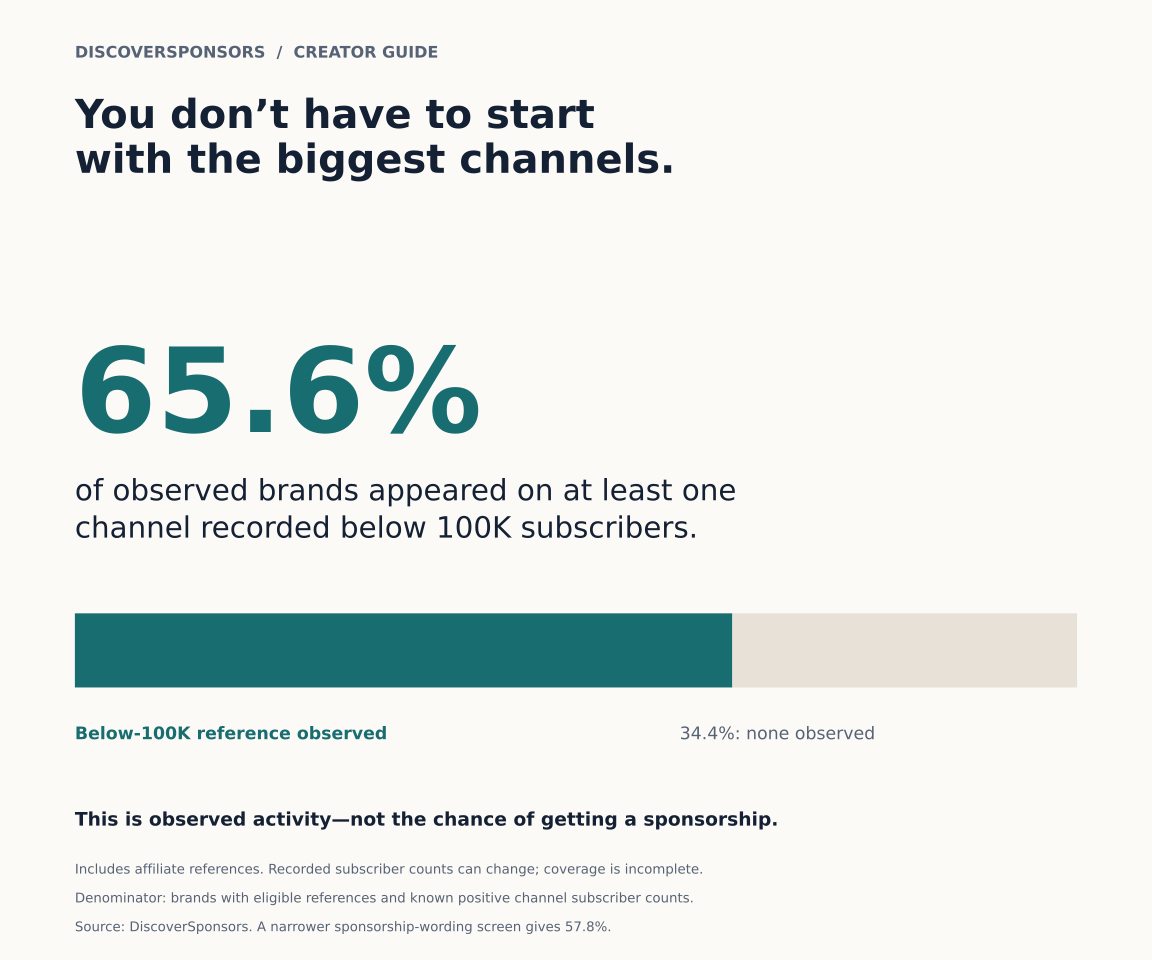
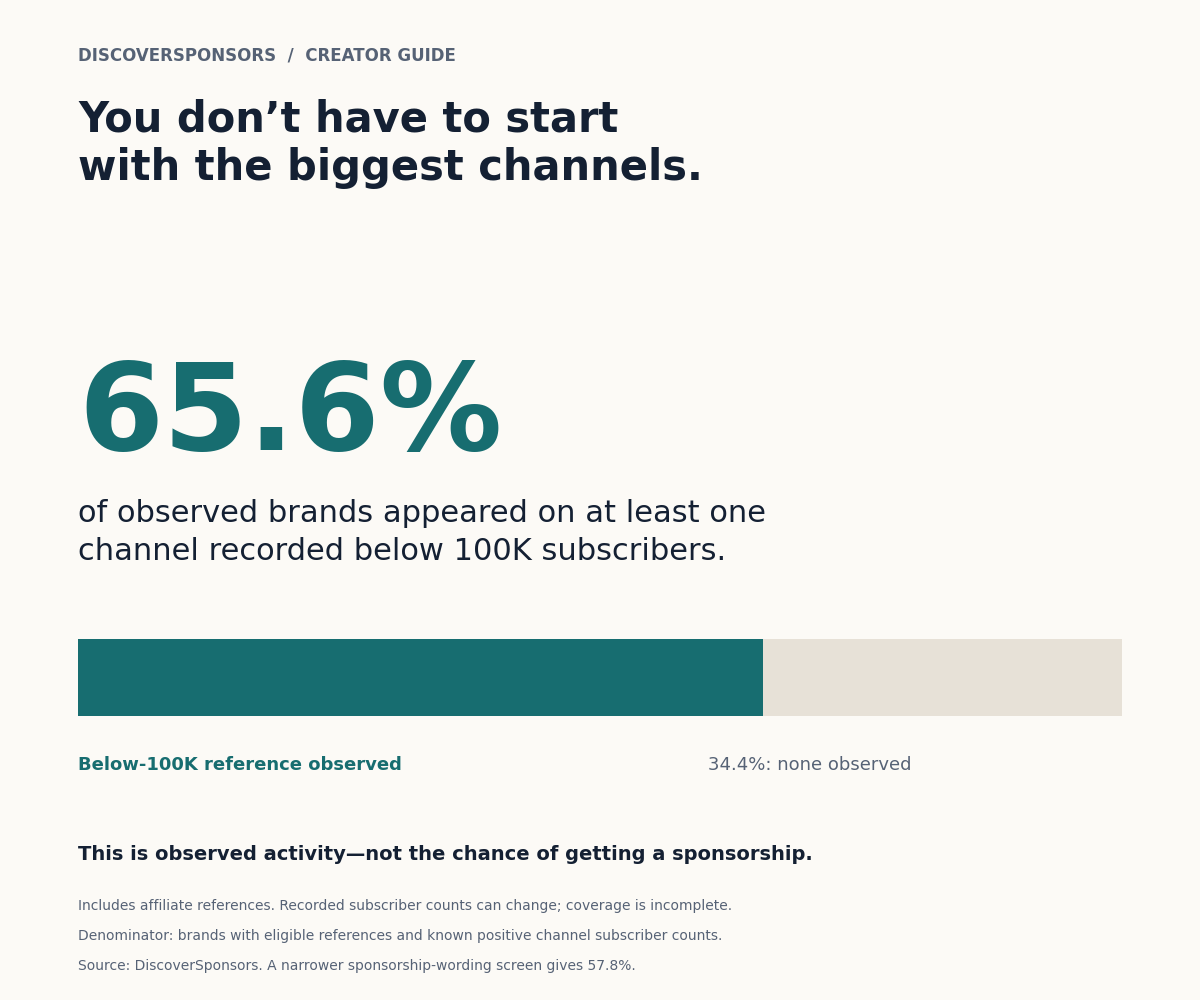
The useful conclusion is that smaller-channel history exists across many brands. Your job is to find the part of that history relevant to your audience.
1. Find comparable creators before collecting brand names
Start with five to ten channels that serve a similar viewer, in a language and market relevant to yours. Look at their recent video views and content format as well as subscriber counts.
For a gaming channel, “gaming” is too broad. A Genshin character-build guide, a competitive shooter tutorial, and a cozy-game review solve different problems for different viewers. Search within your format first.
For example, try searches such as “Genshin build guide sponsored,” “cozy gaming sponsored by,” or “budget PC build paid partnership.” Then inspect the videos and descriptions rather than treating the search result as proof.
Review a few recent uploads from each comparable channel. Record the brand, the source video, the type of promotion, and why its product might belong in your content. Repeated matches across relevant creators deserve a closer look.
2. Use existing smaller-channel activity as a starting point
Here are three brands worth investigating in different types of content. These are selected examples, not a ranking of the best sponsors or a claim that they are accepting applications.
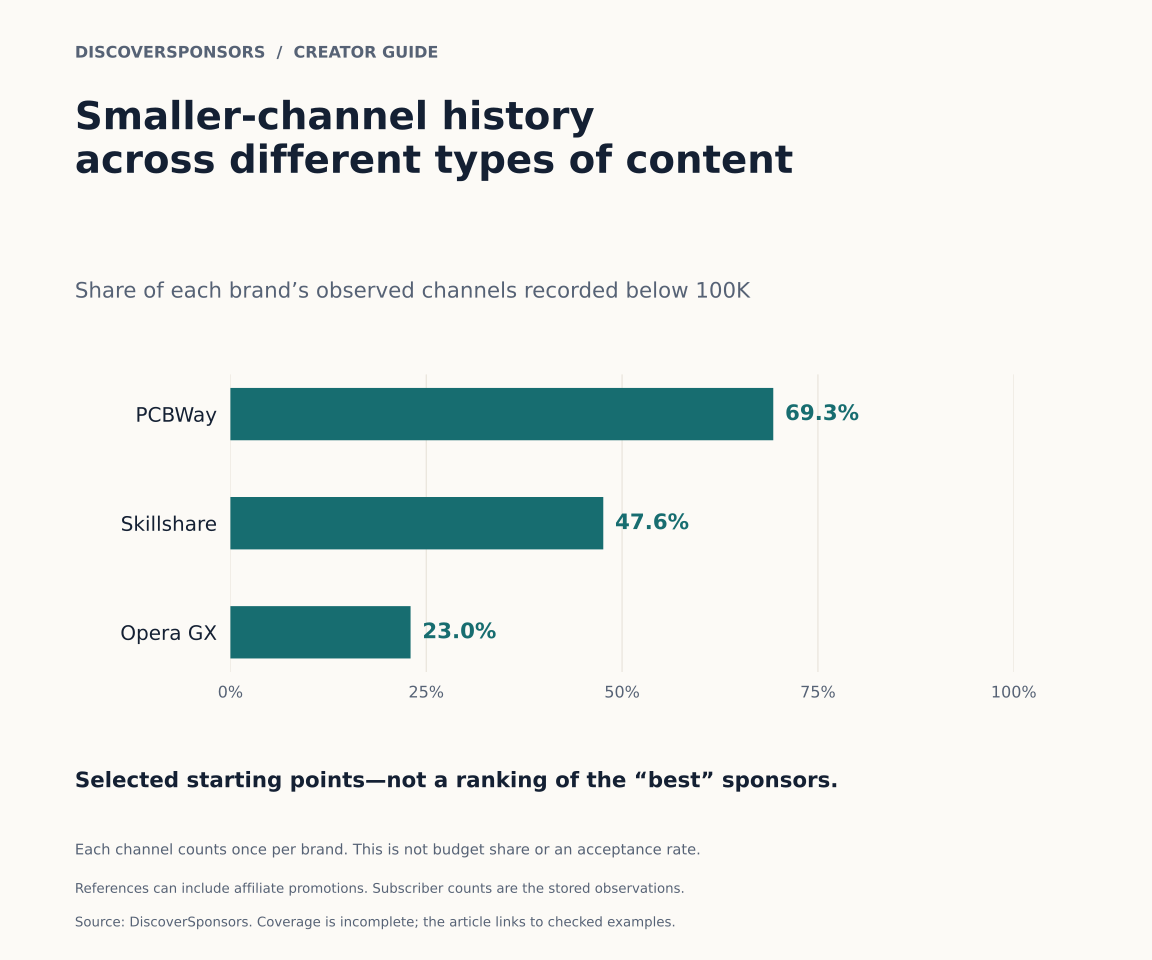
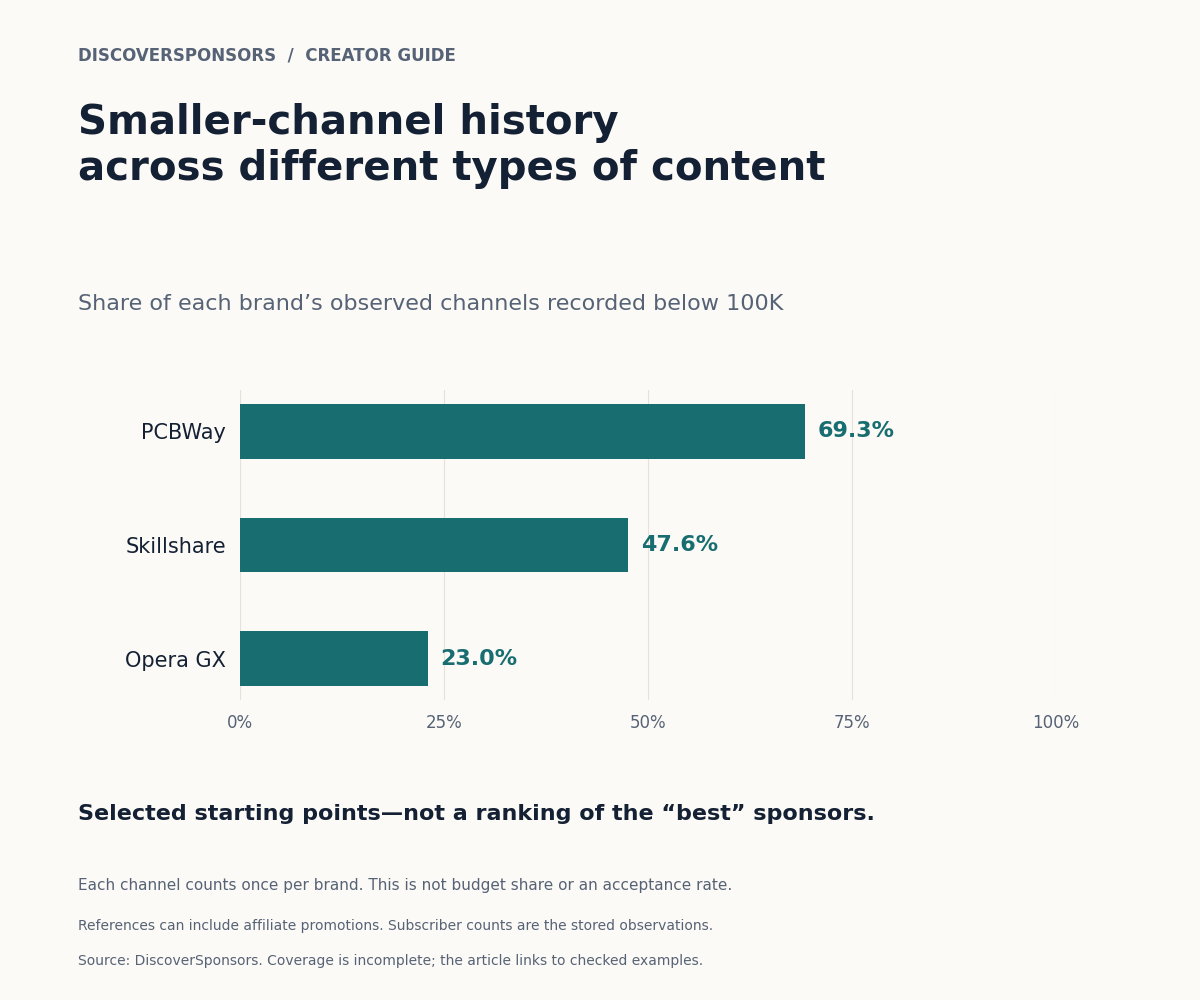
Each percentage uses that brand’s own observed channels as the denominator, counting a channel once. It is not a percentage of the brand’s budget, deals, or replies.
| If you make… | A starting point | Evidence to inspect |
|---|---|---|
| Gaming guides or analysis | Opera GX | TGS’s Genshin analysis, with an explicit Opera GX sponsorship disclosure. TGS had approximately 62K subscribers when checked. |
| Maker, electronics, or 3D-printing content | PCBWay | Lost In Tech’s 3D-printing discussion, with an explicit PCBWay sponsorship disclosure. The channel had approximately 77K subscribers when checked. |
| Creative hobbies or lifestyle content | Skillshare | Ellen Miller’s offline-hobbies vlog, which thanks Skillshare for sponsoring it. The channel had approximately 78K subscribers when checked. |
We checked these descriptions and subscriber counts directly through the official YouTube API. Counts can change; we have not verified the contracts or payment amounts.
Use the examples to develop your search, not to send three identical emails. A gaming browser needs a different audience-fit argument from a manufacturing service or a learning platform.
3. Check the relationship before calling it a sponsor lead
A discount code alone does not establish that the creator received a paid integration. Look for explicit sponsorship wording and inspect the relevant part of the video. Even a disclosed sponsorship does not reveal the fee or whether the brand is currently buying placements.
For each prospect, answer four questions:
- Audience fit: what would your viewers use this product for?
- Comparable evidence: can you point to a relevant creator and source video?
- Partnership type: are you proposing a paid integration, an affiliate arrangement, a product review, or a combination?
- Useful idea: what could you show or explain that fits an upcoming video?
Keep the source link in your notes. “This brand worked with a channel like mine” is a better research starting point than “I keep seeing this logo.”
4. Make the pitch about the audience and the video
Do not make the email an apology for your subscriber count. Give the brand a clear picture of the viewers it could reach and the content you could create.
Prepare a short summary with your channel topic, recent typical video views, relevant audience locations, and one representative video. Use your own analytics. Compare videos over a consistent period, and do not let one viral upload stand in for normal performance.
YouTube’s own brand-deal guidance recommends sharing audience information, performance data, and collaboration ideas. If you are in the YouTube Partner Program, its Media Kit tool is available through YouTube Studio on desktop.
For a gaming creator, an idea might be a relevant product demonstration within an upcoming setup or strategy video. Choose an idea that makes sense for your actual audience; do not invent a connection because you want the sponsor.
Here is a template to adapt:
Subject: [Video idea] for [Brand] × [Channel]
Hi [Name],
I make [specific content] for [specific audience]. My recent [format] videos typically receive [honest view range] within [consistent time period], and [relevant audience detail].
I noticed your partnership with [comparable creator, with source link]. I’m planning [specific video] and could demonstrate [useful product connection].
Are you considering paid creator integrations for [relevant period]? I can send a short outline and audience summary.
[Name] · [Channel link]
Replace every placeholder with something you can support. Use a brand’s creator-partnership contact where one is published, or ask its marketing team where proposals belong. A concise follow-up can be useful; repeated generic messages do not make a weak match stronger.
What to do this week
Choose five comparable channels. Build a shortlist of five brands with evidence and a plausible audience fit. Pick the two strongest matches and write a different video idea for each.
That gives you something useful to improve: the quality of your matches, your proposal, and the responses you receive. Waiting for a round subscriber milestone gives you less to learn from.
DiscoverSponsors can help you research brands appearing on similar channels. Whether you use a tool or do the research manually, keep the evidence attached to the prospect and make the pitch specific to your viewers.
About the data
The percentages describe detected brand references in public YouTube metadata over a roughly six-month publication window. We include active channels with positive recorded subscriber counts and videos at least a minute long with positive recorded views. Simple brand-name spacing and capitalization variants are grouped; repeated videos do not give a channel extra weight in these percentages.
Coverage is incomplete, spans languages and content types, and is not a random sample of YouTube. Channel sizes may have changed since collection; the three named examples were checked separately against current metadata. The overall percentage is 65.8% in a shorter publication window. The 57.8% wording-screen result uses a different subset and does not isolate verified paid contracts.
The study was produced by DiscoverSponsors. It does not measure response rates, sponsor budgets, or a minimum subscriber requirement. The practical workflow is editorial guidance, not a measured prediction of sponsorship success.