Creator guide · Data insights
Do YouTube channels under 100K get sponsors? What 562K sponsored videos say
The share of YouTube channels with at least one sponsor in every subscriber band, 1K to 1M+. The jump comes far earlier than most creators think.
By DiscoverSponsors · 5 min read
Every creator forum has the same question: how big do you need to be before brands sponsor you? The usual answers are guesses. This one is measured.
We index sponsored YouTube videos through the official YouTube Data API: a video counts when its description or paid-promotion disclosure names a brand that paid for the integration. As of September 2026 the index holds 562K sponsored videos published since July 2025, on more than 55K channels. For this analysis we grouped every active channel in the index by subscriber count and asked one question per band: what share of channels had at least one sponsored video in the last 14 months?
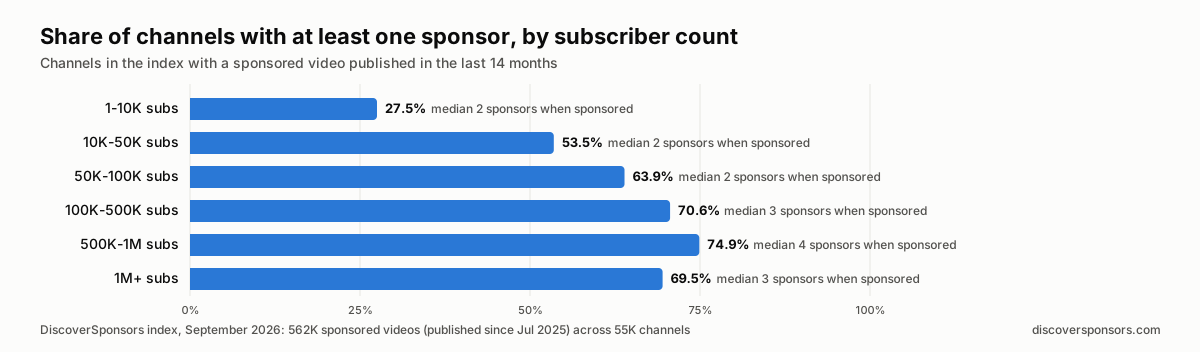
The jump happens between 10K and 50K, not at 100K
| Subscribers | Channels in the index | Share with at least one sponsor | Median sponsors (sponsored channels) | Median sponsored videos |
|---|---|---|---|---|
| 1K–10K | 17.4K | 27.5% | 2 | 3 |
| 10K–50K | 14.4K | 53.5% | 2 | 3 |
| 50K–100K | 5.8K | 63.9% | 2 | 4 |
| 100K–500K | 11.2K | 70.6% | 3 | 5 |
| 500K–1M | 2.8K | 74.9% | 4 | 6 |
| 1M+ | 4.1K | 69.5% | 3 | 5 |
Three things stand out.
- The biggest step is the first one. Between the 1K–10K band and the 10K–50K band the share of channels with a sponsor almost doubles, from 27.5% to 53.5%. Crossing 10K subscribers changes your odds more than any later milestone.
- The curve flattens early. From 100K to 1M the share rises only from 70.6% to 74.9%. Once a channel is past 100K, more subscribers add very little to the probability of having a sponsor at all.
- The biggest channels are not the most sponsored. Channels above 1M subscribers are sponsored slightly less often (69.5%) than channels at 500K–1M (74.9%), and carry a lower median number of sponsors. Large channels often run fewer, longer exclusive deals, and some of their brand work happens off the video description, where we cannot see it.
What a sponsored channel your size actually looks like
The medians are the practical numbers. A sponsored channel with 10K–50K subscribers typically works with 2 brands and has 3 sponsored videos in the window. At 100K–500K it is 3 brands and 5 videos. Nobody at these sizes is drowning in sponsors; the difference between the bands is whether you have any, not how many.
That also tells you what a realistic first year looks like: one or two brands, a few integrations, then repeat business. The creators in the leaderboards for your size are the ones who turned that first deal into a second.
How to use this if you are under 100K
- If you are past 10K, roughly one in two comparable channels in our index has a sponsor. You are not early. Start pitching brands that already sponsor channels your size, with those videos as your proof.
- If you are under 10K, about one in four comparable channels has a sponsor. Deals exist, but they concentrate in niches where the audience is specific and the product is a natural fit. Look at the brands sponsoring the smallest channels in your niche before you pitch.
- Do not wait for 100K. The share of sponsored channels barely changes between 100K and 1M. The milestone that matters for sponsorship is far lower than the one creators usually aim for.
You can see which brands sponsor channels of your size, with the sponsored videos as evidence, on the sponsor leaderboards or by adding your channel for matches ranked by your size, language and niche.
Method and limits
- Counts come from public video information retrieved through the official YouTube Data API. A video is sponsored when its description or paid-promotion disclosure names the brand that paid for the integration; the active window covers videos published from July 2025 to September 2026.
- Channels enter the index through niche and keyword discovery, and channels with sponsors are somewhat easier to discover than channels without. The shares above are therefore higher than the true rate across all of YouTube, especially in the smallest band. The shape of the curve, where the jumps and the plateau are, is the finding; treat the absolute percentages as an upper bound.
- Subscriber counts are current, not the count at the time of each video. A channel that grew from 40K to 120K during the window sits in the 100K–500K band.
- Off-platform brand work (deals with no description mention, product placement without disclosure) is invisible to this method, which is one reason the very largest channels look less sponsored than they are.